

Date: 2 September 2025
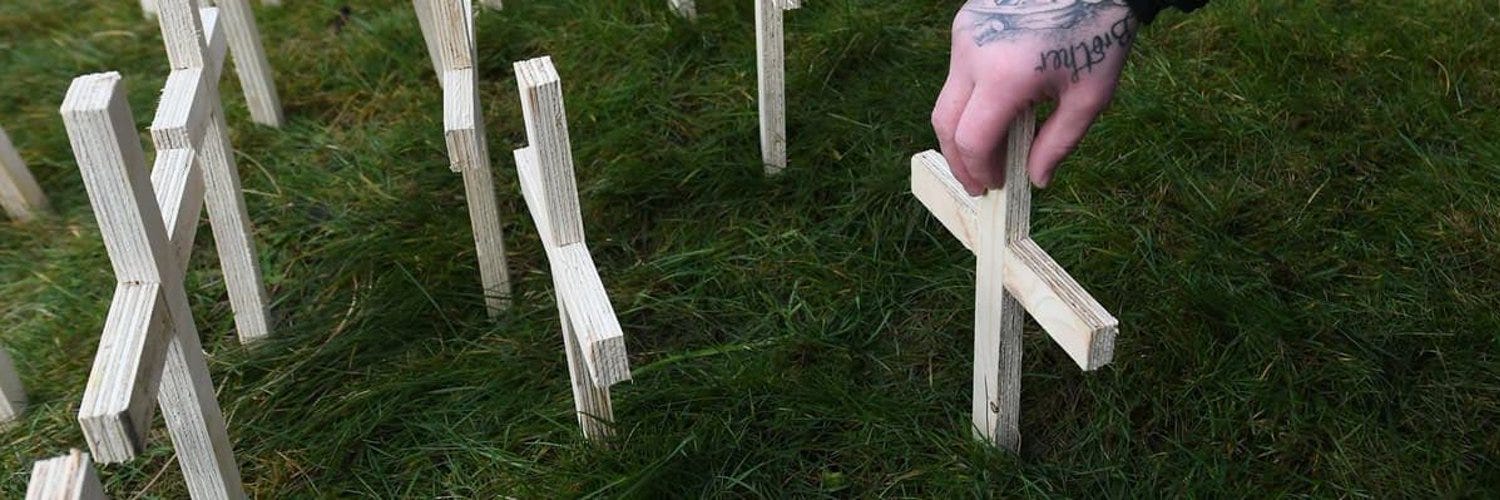
Scotland has been told there were 1,017 drug deaths in 2024. Ministers and their quangos will spend today purring that this is “the lowest since 2017.” But let’s be honest: families are still burying more than a thousand loved ones every single year. That is not progress. That is a national disgrace, graveyard spin, a PR victory carved on tombstones.
And while ministers polish their brass necks, Police Scotland’s own RADAR reports show suspected drug deaths have risen by 33% since January 2024. The crisis is not easing, it is accelerating.
Scotland remains Europe’s drug death capital, with rates three times higher than England. The poorest communities are twelve times more likely to lose their sons and daughters than the wealthiest. Methadone, the government’s sacred cow, was implicated in more than 400 deaths, almost as many as heroin. And now the fentanyl cousins, nitazenes and xylazine, are slipping into supply like wolves into a sheepfold.
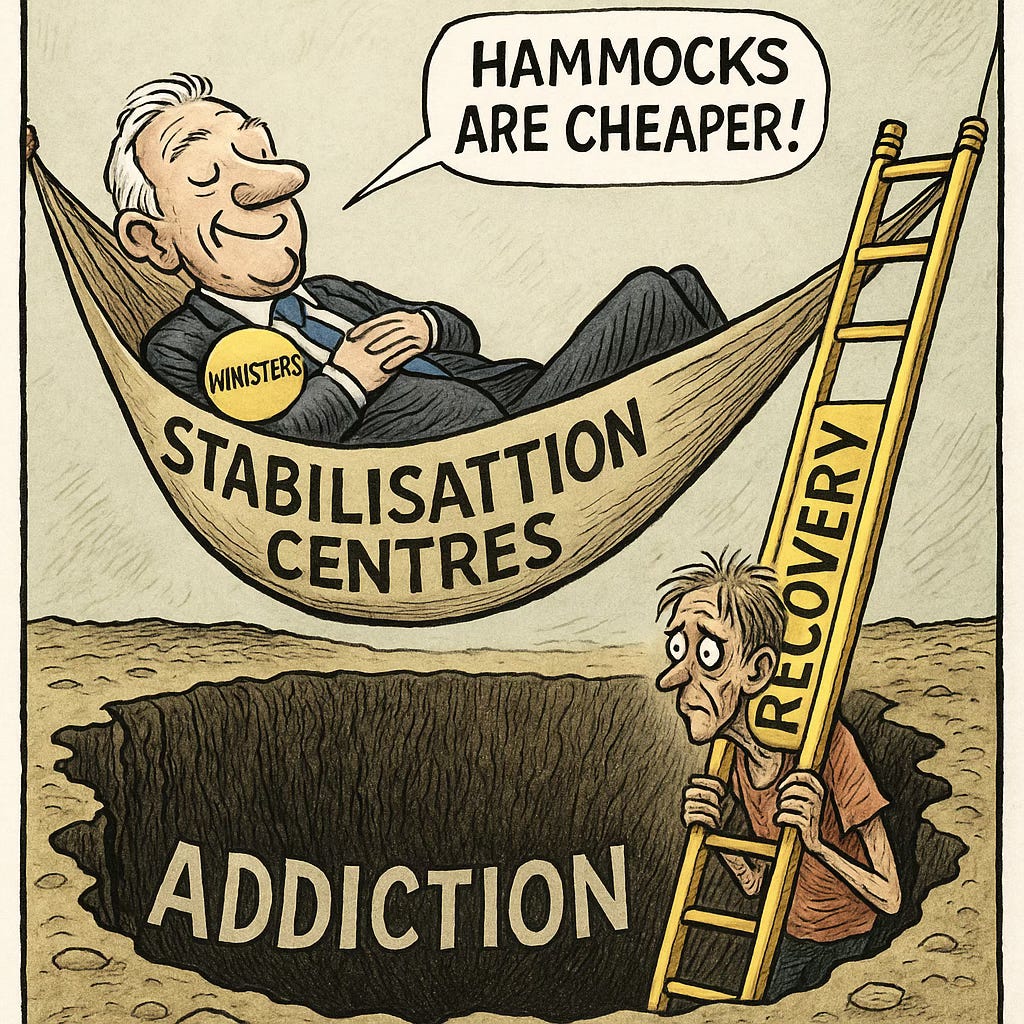
The official response? Providers on government contracts wheeled out to repeat the same catechism: “the policy is right, it’s just not implemented properly.” Their answer to every failure is always the same: fund more “stabilisation centres” a uniquely Scottish gimmick unknown anywhere else on earth.
Addiction cannot be “stabilised.” Without recovery, stabilisation is simply managed decline a pause button on misery, a bureaucratic holding pattern. A placebo policy, sold as reform, delivered as stagnation.
No wonder public trust is gone. Last night in the Calton one of the communities hit hardest the only political representation came from Reform UK councillors. No ministers. No leadership. Just more excuses, more absence, and more grieving families left to fend for themselves. Why because their votes don’t matter. The poor do not vote. Is it any wonder why not.
The Hunter Street Example
Colin McGowan highlighted the reality at Hunter Street’s Drug Consumption Room. On paper, 252 people are registered to inject. Yet over the first 210 days, only 3,500 injections took place an average of just 16 a day. So where are the rest happening? In alleyways, closes, shop doorways but above all, behind closed doors at home. And that matters, because most people die alone in their own home.
This is why the much-touted naloxone rollout, while well-meaning, was always little more than pissing in the wind. It might make sense in countries where drug use is concentrated in open street scenes, but in Scotland the overwhelming majority of fatal overdoses happen in private. The people most at risk are not in supervised rooms, or even on the street , they are isolated, behind a locked door, beyond the reach of bystanders or emergency staff.
That’s also why the drug consumption room idea was never going to work here. In places like Vancouver or Lisbon, the model grew out of concentrated public drug scenes where large numbers of homeless people injected together in one place, main the parks and plaza areas. Scotland’s epidemic looks very different: it is dispersed, hidden, solitary, and overwhelmingly domestic. A single, highly centralised room can never reach that population, they are at home. At best, it becomes an expensive showcase for a handful of people; at worst, it distracts from the real work of building detox, rehab, and recovery services that could help the thousands who will never walk through its doors.
The international evidence backs this up. As Keith Humphreys’ 2024 Brookings report shows, similar policies in Oregon, San Francisco, Seattle, and British Columbia unravelled quickly. Overdose deaths soared, crime and public disorder spiked, and promised expansions in treatment never materialised. Communities revolted, forcing politicians to reverse course. The lesson is clear: copying models designed for very specific street scenes and parachuting them into places with completely different patterns of drug use like glasgow is doomed to fail.
Scotland does not have the open-air drug markets of Vancouver’s Downtown Eastside. What it does have is Europe’s highest rate of , home-based overdoses. That reality makes drug consumption rooms not just ineffective here, but fundamentally inappropriate. But we told them that before it opened.
Voices from the Calton
The testimony from Calton residents last night was furious, raw, and heartbreaking. A mother held up a photo of a needle her child found in the garden. Families described being charged £150 for extra needle uplifts while the council blandly insisted there was “no extra litter.” Shopkeepers spoke of shuttering & closing their businesses. Parents admitted they no longer let their children out to play and they themselves no longer leave the house after dark. Some men said, bluntly, that if this continues they will be driven to take matters into their own hands.
A man in long-term recovery summed it up with painful clarity: “Giving an addict a ‘safe’ room is like giving an alcoholic a plush bar. It does not cure the disease.”
Residents also raised serious doubts about the figures. They believe registration numbers were padded by bringing in people from other services. Even some users admit they only signed up because the postcode is “safe” to score and deal from — the police don’t bother you there.
And then there is the cost. The Hunter Street drug consumption room is expected to burn through £2.3 million a year. That’s £44,240 a week, £6,318 a day, £526 an hour — for 16 injections a day. In practice, it works out at £1,500 per addict, per day. Even if you knock a third off for extras like showers and laundry, you’re still looking at £7,000 a week to keep four people in clean needles. And the real figure is likely higher.
Now compare that to Glasgow’s own preferred provider of residential rehab: £1,000 a week. For that, a person gets detox, therapy, community, and — crucially — the chance of a life beyond addiction. Recovery instead of managed decline. Hope instead of despair.
So the question is brutally simple: why spend seven times more to maintain four people’s habit, instead of funding hundreds of rehab places that could actually turn lives around?
Glasgow’s addiction budget is £50 million. Just £1.3 million of that goes to detox and £300,000 to recovery hubs. The rest props up maintenance prescribing, wound care, Hunter Street’s DCR, the heroin-assisted treatment programme and untold millions swallowed by the so-called stabilisation centre. When the public hear “£50m on treatment,” they picture detox and rehab. In reality, they are paying for a system designed to manage and contain addiction, not to end it.
The meeting last night ended with a minute’s silence, not only for the dead, but for the still-suffering addict.
What the Global Evidence Shows
On the question of “stabilisation centres.”
There is no international precedent for them. None. Across the world, addiction services are built on established pillars: detoxification units, residential rehabilitation, therapeutic communities, and recovery-oriented systems of care (EMCDDA, 2022; Kelly & White, 2021).
“Stabilisation,” by contrast, is a Scottish invention a short-stay holding pattern that provides medication and temporary respite but offers no guaranteed pathway into detox, rehab, or lasting recovery. It does not feature in international best practice or peer-reviewed evidence (Scottish Government, 2023).
Its promotion is the predictable product of a workforce ideologically conditioned to see harm-reduction as treatment in itself, and lacking the professional training or experience to support people into genuine recovery. In short: stabilisation is not treatment, it is managed decline.
Where other countries invest in ladders out of the pit, Scotland has built hammocks. Not for people trapped in addiction who deserve real routes out but for the providers who profit from keeping them suspended in place. The business model is simple: win government contracts, expand “stabilisation,” and promise impact tomorrow while delivering dependency today. Ministers oblige, because hammocks are cheaper to fund and easier to spin than the hard graft of genuine recovery.
This model did not emerge by accident. It was created and defended by a class of ideological experts who view recovery itself as stigmatising, and who regard asking people to get clean as an act of prejudice. As Professor Carlton Brick has highlighted on the CEIO blog here , this is ideological blindness masquerading as compassion a cultural surrender dressed up as policy. “Stabilisation” wasn’t imported from Europe or North America. It was invented here to cover for the glaring absence of detox and rehab beds
.
Accountability
Millions have been poured into Medication Assisted Treatment and stabilisation. Yet methadone alone was implicated in 412 deaths last year. When will ministers admit the model is not working?
Every year a “National Mission.” Every year a “public health emergency.” Every year another thousand funerals. But where are the detox beds? Where are the rehab places? Where are the recovery communities? Families are done with strategies. They want exits.
The Bottom Line
Scotland does not need more slogans, strategies, or gimmick halfway houses. It does not need another round of “stabilisation.” What it needs is detox, rehab, therapeutic communities, and recovery housing. It needs honesty. And above all, it needs fewer funerals.
Addiction cannot be “managed.” If it could, it would not be addiction. Scotland must stop pretending that prescribing and supervised consumption are stepping stones to recovery. They could be but they aren’t. Not when there are no recovery focused services available to access.
LOVE
Christopher Hitchens once observed that there is a difference between a problem and a predicament. A problem can be solved; a predicament must be endured. Our government has chosen endurance. Communities, however, are choosing resistance. The only question is how many more funerals it will take before ministers choose recovery.
And yet, amid all the failure and the spin, there is something ministers cannot smother: the resilience of those living with the consequences.
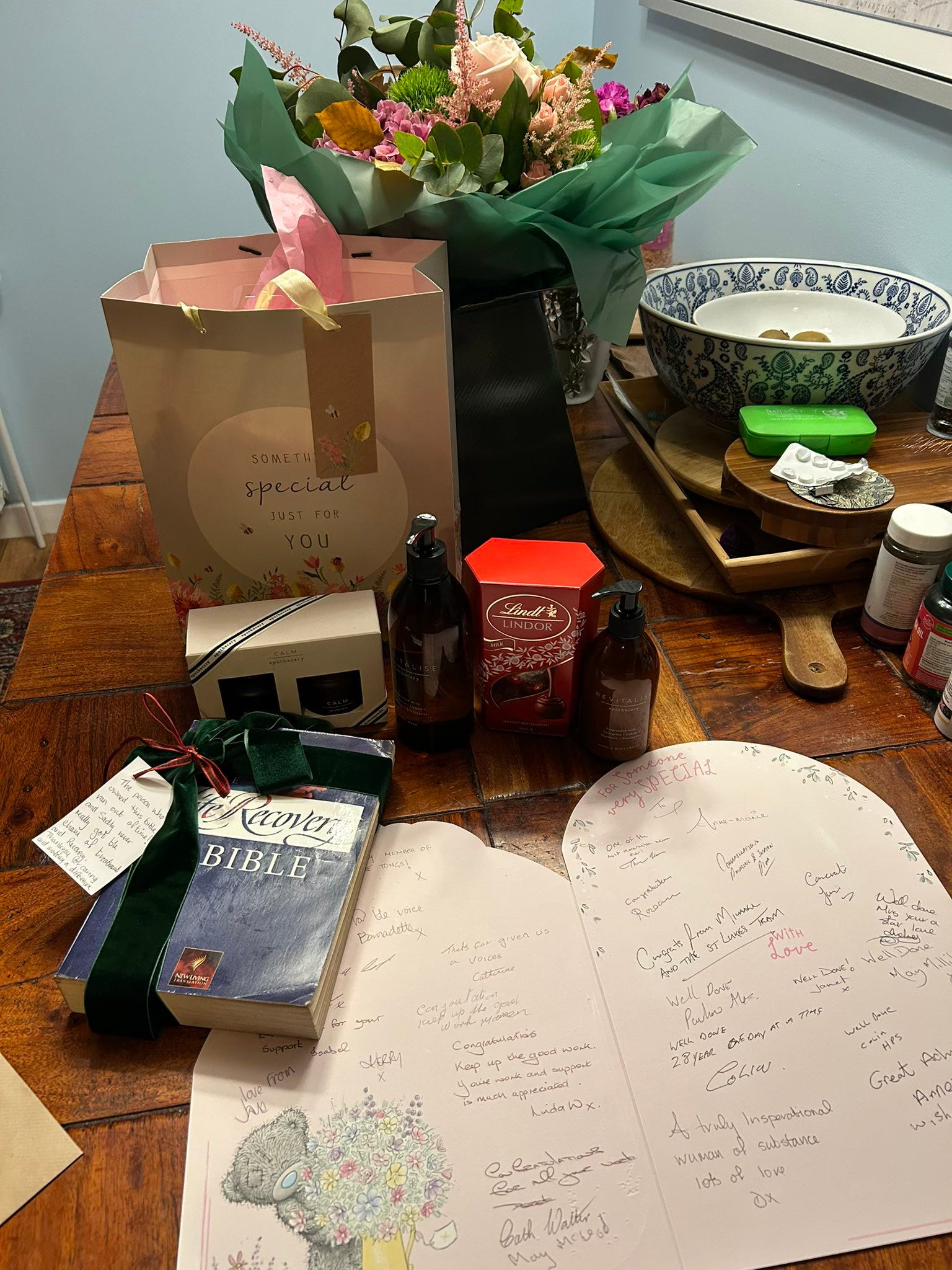
Last night I was deeply moved to receive gifts from the people of the Calton, flowers, chocolates, kind words, and most moving of all, a Life Recovery Bible tied with ribbon. The note on it broke my heart: it had once belonged to someone who never got the chance to see recovery passed on from one who had. A stark reminder of why this fight matters so deeply.
The people of the Calton, like so many in Scotland’s poorest communities, live each day with the fallout of failed policy: discarded needles, open drug use, the slow erosion of their neighbourhood, and the grief of lives cut short far too soon. They are carrying the cost of decisions made in offices miles away, by people who never have to walk these streets.
And yet, in the middle of all that pain, they show remarkable strength, care, and solidarity. Their generosity and love for their community are humbling. I am deeply grateful for their trust. Recovery, dignity, and safety are not luxuries for the few they are rights that belong to us all. And their voices must be heard.